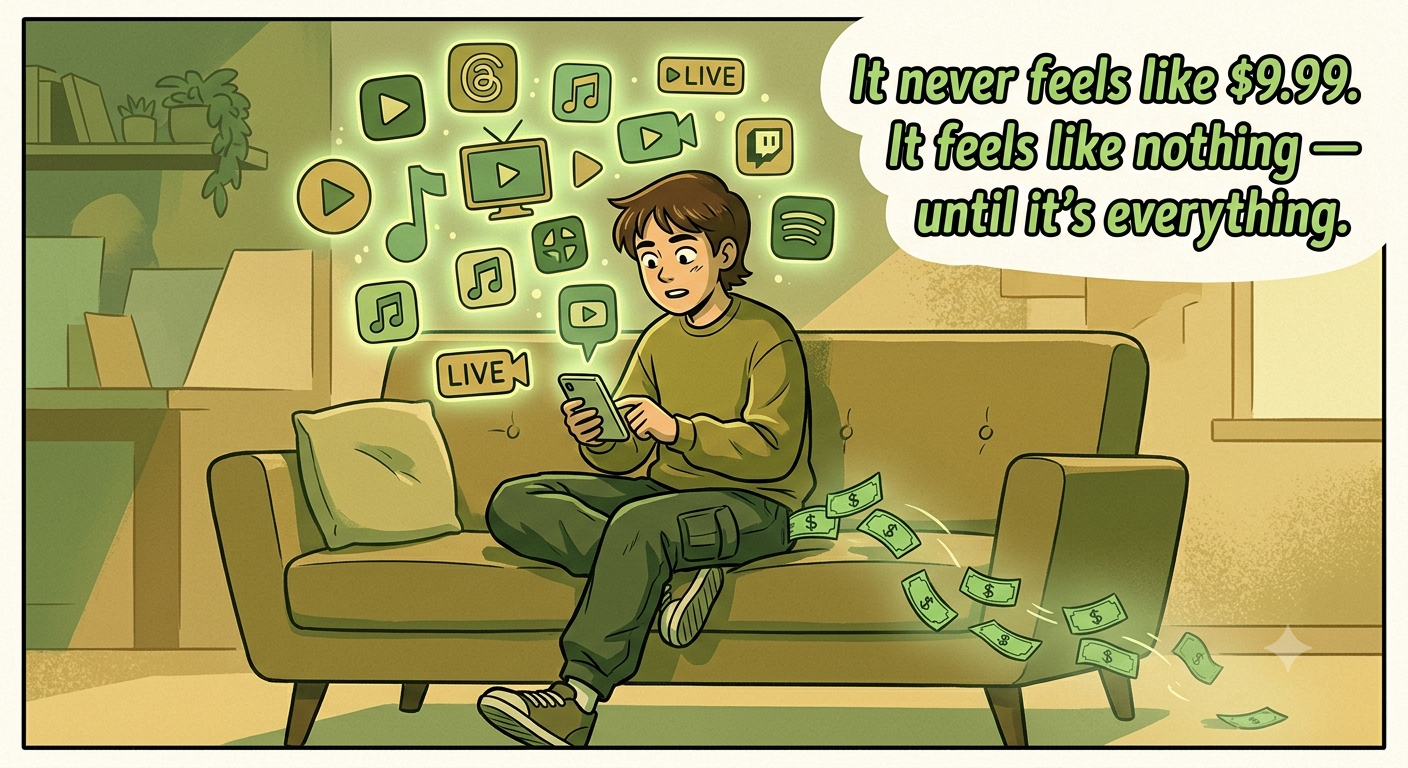
You didn't decide to spend $180 a month on subscriptions. Nobody does. It happened one free trial at a time.
A streaming service here. A meal kit you tried for a month and forgot to cancel. A fitness app you used twice. Cloud storage you upgraded during a late-night phone cleanup and never downgraded. None of it felt like a decision. Each one felt like nothing — $4.99, $9.99, $14.99. Small enough to ignore. Small enough to forget.
That's the trap. Subscription creep doesn't announce itself. It doesn't ask permission. It just quietly compounds in the background while your bank account gets a little lighter every single month, on autopilot, without you ever having to say yes twice.
The Math Nobody Does
Here's the exercise almost nobody actually runs: open your bank statement and highlight every recurring charge you see. Not the big ones you're proud of — rent, your phone bill. The small ones. The ones you'd struggle to explain if someone asked you why you're paying for them.
Most people who do this exercise are shocked. $12 here, $8 there, $20 somewhere else — and suddenly it's $150 to $250 a month in things you're not actively using or even remembering you have.
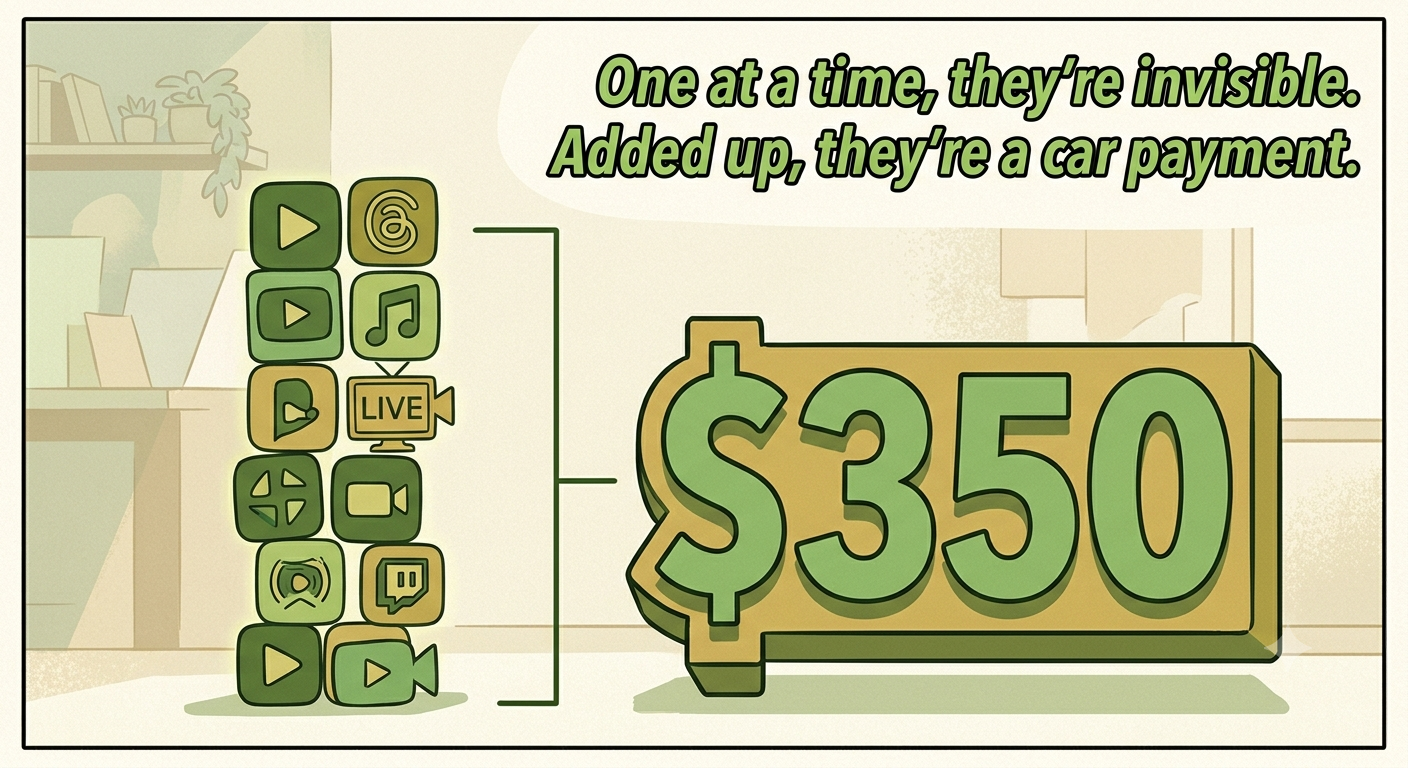
$200 a month doesn't sound like much when it's broken into six pieces. But $200 a month is $2,400 a year. That's a plane ticket. That's a semester of textbooks. That's a meaningful head start on an emergency fund. It's not a small leak. It's a slow one — and slow leaks sink boats just as surely as big ones.
Why This Hits Young Adults Hardest
This isn't a willpower problem. It's a design problem. Subscription businesses are built by people whose entire job is making sure you forget you're paying them. Free trials convert automatically. Cancellation flows are buried three menus deep. Pricing is framed in small numbers ("just $7.99/month!") so it never feels like the $96/year it actually is.
You're not bad with money because you have six subscriptions. You're normal. The system is built to make this happen to everyone. The only difference between people who lose $200 a month to it forever and people who don't is whether they ever stop and look.
The Three-Step Audit
Treating your money well doesn't mean cutting out everything you enjoy. It means knowing exactly where it's going, on purpose, instead of by accident.
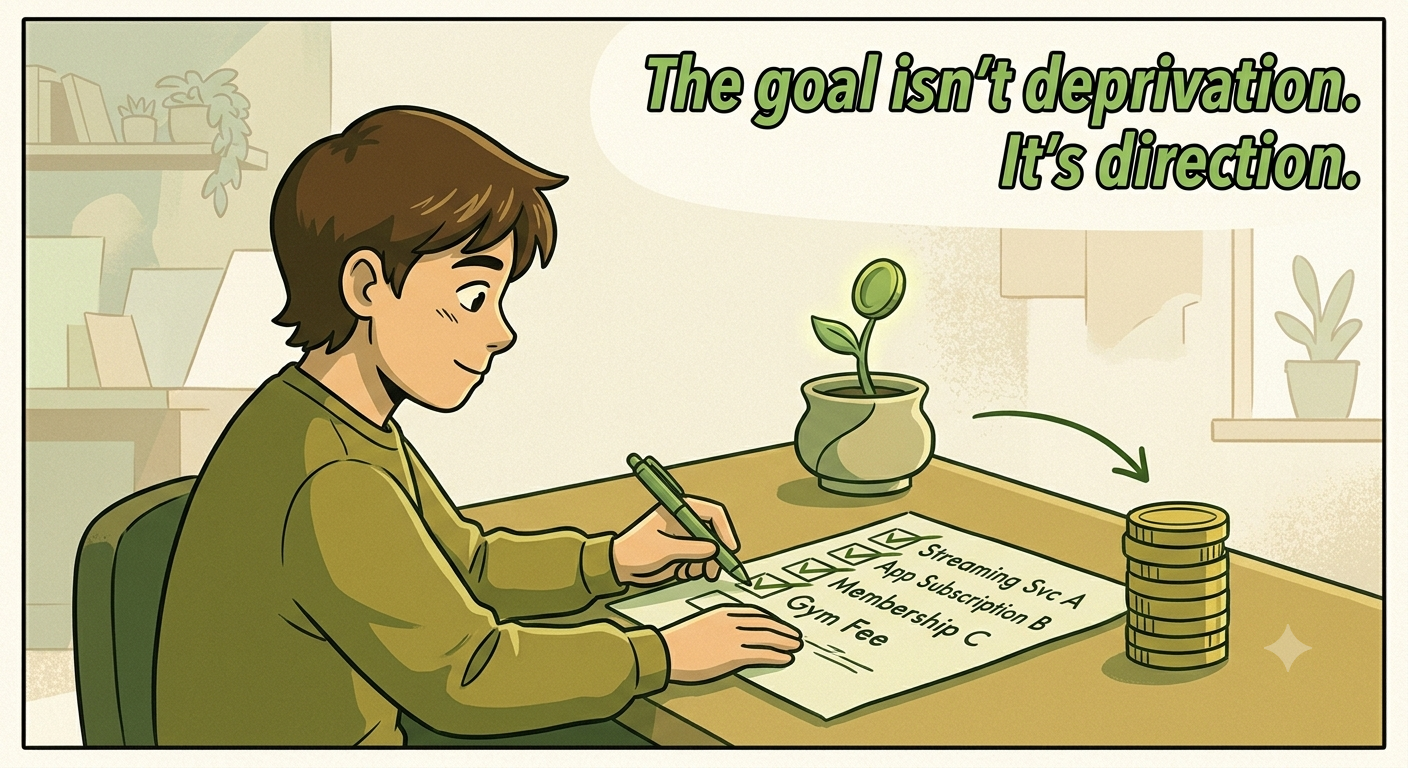
1. Find every recurring charge. Go through your last two bank or credit card statements. Every charge that repeats monthly or yearly gets written down, no matter how small.
2. Ask one honest question per subscription. Not "do I like this?" — almost everything passes that test. Ask instead: "Did I use this in the last 30 days?" If the answer is no, that subscription isn't buying you joy. It's buying the streaming service's shareholders a coffee.
3. Cancel or downgrade, don't just note it. This is the step people skip. Writing "I should cancel this" in a notes app changes nothing. Actually canceling it — today, while you're looking at it — is the only step that puts money back in your pocket.
Redirect It, Don't Just Cut It
Here's the part that makes this actually stick: don't let the money you free up just evaporate back into your checking account and disappear into other small purchases. Redirect it on purpose. Set up an automatic transfer the same day you cancel a subscription — even $15 or $30 a month — straight into your savings or your first index fund.
This is the same quiet habit that runs through everything else on this site: it's not about restriction. It's about making sure your money is working for the life you actually want, instead of quietly leaking out toward things you forgot you were paying for.
Do this audit once a quarter. It takes fifteen minutes and it's one of the highest-return fifteen minutes you'll spend all year.
Next up: building your first automatic savings system so the money you just freed up doesn't just sit there — it grows.
If this resonates with you, this is exactly the philosophy that Money Matters is built on — the practical system for treating your money well, in plain language, with worksheets to put each idea into practice.
Visit MoneyMatters.website to grab a copy of the book, download the free worksheets, and look around. The way you treat your money this year is the life you live ten years from now.
— William S. Baker